
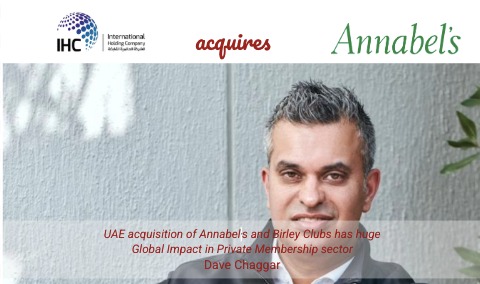
IHC acquiring Annabel’s and Birley Clubs insights from Dave Chaggar
The acquisition of Annabel’s and the wider Birley Clubs portfolio is far more than a high-profile transaction. It is a calculated, strategic move that underscores the UAE’s growing authority as a global capital allocator with cultural influence.
As noted by Dave Chaggar, the UAE has built a reputation for deploying smart capital. Capital that does not simply acquire assets, but elevates them, scales them, and positions them on a global stage.
To understand the significance of this acquisition, one must first appreciate the heritage of Annabel’s. Founded in 1963 by Mark Birley in London’s Mayfair, Annabel’s quickly became one of the most exclusive private members’ clubs in the world. Named after his wife, Lady Annabel Vane-Tempest-Stewart, the club was conceived as a sanctuary for the elite – a place where royalty, Hollywood icons, political leaders, and global tastemakers could gather in absolute discretion.
Over decades, Annabel’s evolved into a symbol of status and belonging. Figures ranging from Queen Elizabeth II to Frank Sinatra and Kate Moss have been associated with its legacy. It has never simply been a venue – it is an institution, defined by its meticulous attention to detail, its opulent interiors, and an uncompromising commitment to exclusivity.
Under the stewardship of Richard Caring, Annabel’s entered a new era, culminating in its 2018 relaunch at 46 Berkeley Square – an ambitious reinvention that preserved its heritage while modernising its appeal for a new generation of global elites.
Maintaining Caring as Executive Director is therefore a masterstroke. It ensures continuity of vision and safeguards the intangible elements that make Annabel’s unique – its culture, its discretion, and its identity – while unlocking new opportunities for expansion.
This is where the UAE’s broader strategy becomes particularly relevant.
“We have seen it with how the UAE has invested smartly and strategically. They have perfected the mix of maintaining brand integrity whilst putting their investments on the highest stage globally. The same will happen with Annabel’s. From being the most renowned brand in private membership, it can now be a dominant force beyond imagination”
Over the past two decades, the UAE has systematically diversified its investments across sectors that combine cultural cachet with long-term economic value. In sport, the acquisition of Manchester City F.C. by City Football Group transformed not just a club, but an entire ecosystem – a global network of teams and a powerful commercial platform.
In aviation, Emirates and Etihad Airlines have become synonymous with premium global travel, while in hospitality, brands like Burj Al Arab have redefined luxury itself. Meanwhile, investments through entities such as Mubadala Investment Company and ADQ continue to span technology, healthcare, infrastructure, and energy positioning the UAE at the centre of future-focused industries.
What ties these investments together is a clear philosophy: preserve brand integrity while amplifying global reach.
Annabel’s fits perfectly within this framework. It is not just a hospitality asset – it is a cultural brand with global resonance. Its acquisition signals an intent not only to own prestige, but to export it.
If Annabel’s were to establish a physical presence in the UAE particularly in hubs like Dubai or Abu Dhabi, the implications would be profound. The region’s private members’ club landscape would be instantly redefined. Expectations around exclusivity, design, service, and curation would rise dramatically.
Membership at Annabel’s has always been aspirational. An emblem of access to a rarefied world. In the UAE, that aspiration would be amplified by a market already attuned to luxury, experience, and status.
At the same time, the competitive landscape is intensifying. A wave of members clubs from the UK, Europe, and the Far East are actively exploring entry into the UAE, recognising the region’s unique combination of wealth, global connectivity, and appetite for high-end experiences.
Yet, as Dave Chaggar suggests, Annabel’s would not merely participate in this competition. It would define it.
Much like the UAE’s transformative approach in football, this move has the potential to set a new global benchmark. From being the most renowned name in private membership, Annabel’s could evolve into a multi-market powerhouse. One that shapes the future of elite social spaces worldwide.
In that context, this acquisition is not just significant. It is strategic, symbolic, and game-changing.