
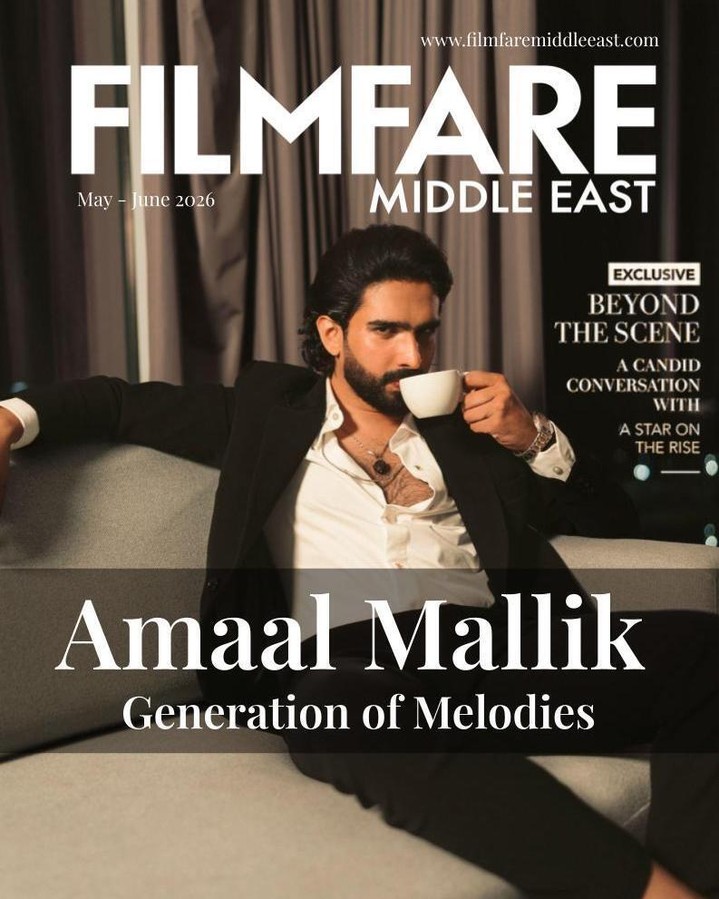
AMAAL MALLIK
The Man Behind A Generation Of Melodies
From Bollywood chartbusters to global collaborations, the composer-musician turns 36 reflecting on legacy, reinvention, and creating music that transcends borders.
Journey & Legacy
-At 36, when you look back at your journey so far, what feels most surreal to you today? At 36, what feels most surreal is that I’ve already lived through so many highs and lows that most artists probably never even get to experience over an entire lifetime. I’ve seen stadiums sing my songs back to me, I’ve seen 5 to 7 year long relationships that have ended up in heartbreak 3 times, insane amounts of self-doubt as a 16 year old, blamed for being a nepo kid, yet never had anyone have my back in this industry that’s filled with dirty politics, success at 23, setbacks and failures through the last 7-8 years.
Whatever I went through I made it into a composition. My song’s lyrics speak the words I left unsaid to the ones I loved once, and the melody soaks in the pain of my heart that never forgave me for being unable to express in the real world how I truly feel about people.
What feels surreal is that a kid who was just sitting in his room making melodies on a keyboard became the soundtrack to people’s love stories, breakups, weddings, late-night drives, baby showers, bridal showers, and that’s a very powerful feeling.
Sometimes I still hear a song or soundtrack of mine playing somewhere randomly and I pause for a second thinking, “Damn, I made that at 24.” I did MS Dhoni the Untold Story at that age and it’s been a dream run the last entire decade.
When I look back today, I don’t just see hits or charts. I see resilience. i see true love in the eyes of my audience. I see a boy carrying a musical legacy, trying to create an identity of his own, and slowly becoming an artist people genuinely connect with. That feeling is bigger than fame for me.
-You come from one of India’s most respected musical families, but you’ve built a very distinct identity for yourself. Was that pressure or motivation growing up? Growing up in a musical family is a blessing, but it also comes with a shadow. People assume the path is easier for you, but what they don’t see is the pressure of constantly being compared to the greats before you – My grandfather Sardar Malik began this musical journey in 1951, then it was carried by Hasrat Jaipuri (Prolific Writer, Wrote Ehsaan Tera Hoga Mujhpar) the great writer who happens to be my dadi’s elder brother, Anu Malik, then in 2001 it was Daboo Ji my father, and then. Come 2014 it’s been Armaan and I.
But even before you’ve had the chance to discover who you are, before you even fail you’re already being set up for failure. They wrote me off like bad debts. This place and its people tried to bury us, but they didn’t know we were seeds. Personally if you ask me, For me, it was always both: pressure and motivation. Pressure because I knew the surname carried expectations, and motivation because I was surrounded by greatness every single day.
Music wasn’t just a profession at home, it was emotion, discipline, conversation and everything in between. But very early on, I realised I didn’t want to be “the next” anyone. I wanted people to hear a song and instantly feel that it sounds like an Amaal Mallik composition. That individuality became my biggest driving force. I think over the years, through my melodies, heartbreak songs, romantic ballads, even the vulnerability in my music, I’ve managed to create a space that feels authentically mine….
-You began composing for films at a very young age. Do you think starting early shaped your understanding of fame and success differently?
Absolutely. When success comes to you very early, you realise quite quickly that fame is temporary, but your craft is what stays. I entered the industry as a teenager at 15 assisting Amar Mohile on the score of Sarkar (2005) and suddenly I was in rooms with filmmakers, actors, producers, people I had grown up watching. It was exciting, but also overwhelming at times.
I think starting young made me emotionally grow up faster. You learn very early that one Friday, one release can make you feel on top of the world, and the next can make you doubt yourself completely. So I stopped chasing validation after a point. I became more focused on creating music that genuinely connects with people. Also, because I started so young, music became less about glamour and more about responsibility for me.
I understood that when someone listens to your song during the happiest or lowest phase of their life, you can’t take that lightly. That perspective shaped me not just as a composer, but as a person too.
-You’ve often spoken about melody being at the heart of your music. In an era driven by trends and algorithms, why do melodies still matter to you?
Because melodies outlive trends. A sound can trend for 15 -30 seconds, but a melody can stay with you for 15-20 years. That’s the difference. I come from a school of music where emotions were always the hero. When people hum a song years later without even realising it, that’s the power of melody. You can strip away the production, the visuals, the marketing, but if the melody touches your soul, the song survives generations.
Due to marketing some may look less successful but if you hear any of my underrated songs they are special and how. They may be underrated today but might become a cult tomorrow, one can’t predict these things. Hence I just create and forget ! I think today we live in a very fast-moving world where music is consumed quickly & forgotten quickly too….
We as musicians have been a by-product of the Hindi film industry. There’s nothing wrong with experimenting or adapting to newer sounds, like Dhurandhar is a benchmark for all of us. So I do that study as well from time to time, about the evolving soundscape of our country’s music, study the audience a little as to what is defining their playlists, as it is also quite important today.
Kids don’t only care about melody, they need a bassline, a thump, a riff, a recall, a quick dopamine hit, but keeping all this at the back of my mind I still never want to lose the emotional core of a song.
For me, melody is all about honesty. Lyrics are the soul that enters the room of honesty. I only believe music is the reason people express things unsaid, and that ability in me makes me work hard. People feel something deeply through me and my music.. Even in a world full of noise., numbers and algorithms, I choose my art !
-Looking back, was there one song that changed everything for Amaal Mallik? Sooraj Dooba Hai did everything I could ever ask for, I was about to quit music and that’s when Sooraj Dooba Hai came and changed everything for me and my family.
Grateful to lyricist Kumaar for writing this one for me when I needed a successful song the most. This one song had opened doors like never before.
The Sound of Amaal Mallik
-Your music moves seamlessly between soulful ballads and large-scale commercial hits. How do you balance artistic emotion with mainstream appeal?
I’ve never looked at emotion and commercial appeal as two separate things. The biggest songs are usually the ones that make people feel something genuinely. Whether it’s a heartbreak ballad or a massive dance track, the emotion has to be real. That’s what connects.
I think my approach has always been instinctive. Sometimes a song needs intimacy and silence, and sometimes it needs scale, energy and celebration. As a composer, my job is to understand the soul of the song first, and then build the sound around that emotion instead of chasing what’s trending.
Of course, there’s always pressure in the mainstream space to deliver hits, numbers, and virality, but I’ve realised that audiences are smarter than we give them credit for. They can tell when music is made from the heart and when it’s manufactured. So I try to keep that honesty intact, even in the biggest commercial songs. That balance is what defines my sound today.
-You were among the earliest composers to bring EDM influences into Bollywood while still retaining strong Indian melodic roots. How consciously did you shape that sound?
It was very conscious, but it also happened very organically because that’s the music I was consuming at the time. I grew up listening to Indian melodies at home, but outside of that I was heavily influenced by Global pop, EDM, electronic music, synth-driven production… artists like David Guetta, Swedish House Mafia, Avicii, Porter Robinson, Knife Party, Skrillex all were favourites.
In Bollywood,Electronic Music was beautifully blended and commercialised by A. R. Rahman, Salim Sulaiman, Sandeep Chowta, Viju Shah, Vishal Shekhar, & last but not least, the master of multi genre Blockbuster Bollywood Music – Pritam Da, all of it shaped me in different ways.
When I started composing, I didn’t want Bollywood music to sound like a copy of the West, but I also didn’t want it to feel sonically dated. So the idea was always to merge modern production with melodies that still felt emotionally Indian at their core. That balance became my identity very early on.
I think songs connect globally when they feel emotionally rooted but sonically contemporary. That’s something I’ve always believed in. Even today, when I experiment with newer sounds, the melody and the Indian soul of the music remain untouched. That’s non-negotiable for me.
-Your compositions often feel cinematic yet deeply personal. Where do you emotionally draw from while creating music?
I think the most honest answer is, I draw from life. From conversations, heartbreak, silence, loneliness, hope, all the emotions we sometimes struggle to put into words. Music became my way of expressing the things I couldn’t always say out loud.
I’ve always believed that the more personal a song feels to the creator, the more universal it becomes for the listener. A lot of my compositions come from real emotional spaces I’ve
experienced at different phases of my life. That’s probably why people often feel such a strong personal connection to them.
Cinema also plays a huge role in how I think musically. I don’t just compose songs, I visualise emotions, moments, memories. I imagine what a character is feeling internally, even in silence. That cinematic approach naturally becomes a part of my sound. But at the core of it all, the emotion is always real. If I don’t feel something while creating a melody, I know the audience won’t feel it either.
-How important has your Western classical training been in shaping your musical language today?
My Western classical training gave me discipline and structure as a musician. It taught me how to understand harmony, arrangements, dynamics, composition, the technical side of reading and writing music, the Italian terminology, that helps you translate emotion into something concrete yet timeless. I think it shaped the foundation of how I hear and build music today.
At the same time, I was also growing up around Indian melodies, film music, ghazals, devotional music, so my sound naturally became a blend of both worlds. The western classical training refined my musicality, but the Indian emotionality gave my music its soul. I’ve always believed that technique alone doesn’t make great music. It gives you the tools, but emotion gives the music life.
My training helped me become more fearless while experimenting with sounds, orchestration and global influences, but no matter how modern the production gets, I still approach melodies from a very emotional and instinctive place.
-Is there a song from your discography that you believe deserved even more love than it received?
Zaroorat se Zyada from Vedaa.
Independent Music & Global Collaborations
-Your independent music has connected deeply with listeners. Does creating outside films give you a different kind of freedom?
Does creating outside films give me more freedom?
Absolutely. Independent music is probably the purest form of expression for an artist because there are no characters, scripts or cinematic situations shaping the emotion for you. It’s just you, your thoughts and your truth.
In films, your job is to serve the story, which I enjoy as well because cinema has shaped me as a composer. But independent music allows me to speak more directly as Amaal Mallik the person, not just Amaal Mallik the film music director.
Songs like Tu Mera Nahi, Chalo Theek Hai, Mohabbat, Yahin Guzaar Doon which released recently came from very personal emotions & spaces, and I think listeners could feel that honesty instantly. Even with songs like Pyaar Ek Tarfaa, the emotion felt extremely intimate and unfiltered to me.
I think that’s why people connect so deeply with independent music today. They’re searching for honesty. And for me, creating outside films has been incredibly liberating because it reminds me why I fell in love with music in the first place, not for numbers or charts, but for emotional connection.
-Collaborating with global artists like Dua Lipa, U2, and Matteo Bocelli marked a huge moment for Indian music internationally. What did those experiences teach you?Collaborating with global artists like Dua Lipa, U2 and Matteo Bocelli was a huge moment not just personally, but also for Indian music globally. It felt amazing to see Indian composers and melodies being part of conversations on an international stage in such an organic way.
More than anything, those experiences taught me that authenticity travels the farthest. I realised you don’t need to imitate the West to connect globally. The world is actually looking for unique voices, cultures and sounds. The more honest and rooted you are in your identity, the more people connect with your music emotionally.
Creatively, it also gave me a different kind of freedom. Working with artists from different musical worlds pushes you out of your comfort zone and expands your perspective on sound, songwriting and storytelling.
But despite all the global influences, I always carried my Indian melodic sensibilities into those collaborations. That balance between being rooted and being global is something I’ve learnt is incredibly powerful today.
-Do you think Indian musicians today are finally being seen as global collaborators rather than just regional artists?
I think Indian musicians today are no longer being viewed through a regional lens alone, they’re being recognised as artists with a unique cultural identity that can contribute meaningfully on a global stage. That shift has been beautiful to witness.
For a long time, international collaborations with Indian artists were often looked at as novelty moments. But today, the world is genuinely curious about Indian sounds, melodies, languages and storytelling. Whether it’s film music, independent music, folk influences or even the way we approach emotion in songs, there’s a richness to Indian music that people across the world are connecting with now.
I also think streaming and digital platforms have changed everything. Audiences don’t care about geographical boundaries the way they used to. If a song makes them feel something, they’ll embrace it regardless of the language. That has opened doors for Indian musicians to be seen as equal creative collaborators, not just representatives of a region.
And honestly, I feel we’re only getting started. India has some of the most emotionally powerful and melodically rich music in the world. The global spotlight is finally catching up to that.
-You are the only Indian artist after A. R. Rahman to perform with the Melbourne Symphony Orchestra. What did that moment mean to you emotionally, both as an artist and as someone representing Indian music on a global stage?
That moment was deeply emotional for me because it felt bigger than just a performance. Standing there with the Melbourne Symphony Orchestra, knowing that the only Indian artist to have done it before me was A. R. Rahman was honestly surreal. Rahman sir has been one of the biggest inspirations of my life, so even being mentioned in the same sentence felt incredibly humbling.
But beyond the personal achievement, it was a proud moment for Indian music. To hear my compositions being played by a full symphony orchestra, with that scale, depth and emotion, reminded me how universal melodies really are.
Music doesn’t need translation when it comes from an honest place.
Emotionally, I think it was one of those rare moments where you pause and truly absorb how far you’ve come. From making songs in a studio room in Mumbai to performing with one of the world’s most respected orchestras, It felt like a full-circle moment for the dreamer in me.
-Is global music expansion something you actively envision for yourself in the coming years?
Definitely. Expanding globally is something I genuinely envision for myself, but not in a way where I abandon who I am musically. My dream has always been to take Indian melodies, emotions and storytelling to a wider global audience while still staying rooted in my identity.
I think we’re at a very exciting point where the world is far more open to diverse sounds and cultures than ever before. Earlier, artists had to fit into a certain mold internationally, but today individuality is what stands out. That gives Indian musicians a huge opportunity to create global music without losing their essence.
For me, the goal is to build music that feels emotionally universal. Whether someone understands the language or not, they should still feel the emotion behind the melody. I want to collaborate across cultures, experiment with newer sonic landscapes, perform on bigger global stages and continue pushing Indian music into spaces where it naturally belongs.
But at the core of it all, I still want every song to sound honest and emotionally real. That’s the one thing I never want to lose, no matter how global the journey becomes.
The Industry & Evolution
-You’ve worked across film music, independent pop, live performances, production, and entrepreneurship. What excites you most creatively right now?
What excites me the most creatively right now is the freedom to evolve without boundaries. I’m at a phase where I’m no longer looking at myself only as a film composer. I’m exploring music as a complete creative universe, whether that’s independent music, live experiences, global collaborations, production or building platforms and opportunities beyond just songs.
Independent music especially has been very exciting for me because it allows me to speak more honestly and directly. At the same time, live performances have given me a completely different high emotionally. There’s something incredibly powerful about watching thousands of people sing your melodies back to you in real time. It reminds you why music matters.
I’m also very excited by the idea of pushing Indian music sonically into newer spaces while still keeping the emotional depth intact. I think audiences today are far more open to experimentation than before, and that gives artists the confidence to take creative risks.
More than anything, I think I’m excited by growth, the idea that I still haven’t discovered every version of myself as an artist yet. That curiosity keeps me hungry creatively.
-Do you think audiences today consume music differently compared to when you started?
The way audiences consume music today is completely different from when I started. Earlier, songs had time to breathe. People would live with an album for months, discover layers slowly, build emotional memories around the music. Today, because of streaming and social media, consumption has become much faster and more immediate.
Attention spans have changed, trends change overnight, and virality plays a huge role now. A song can become a global hit within hours, which is incredible, but at the same time music can also disappear very quickly. That pressure to constantly stay visible didn’t exist in the same way earlier.
But I don’t necessarily see that as a bad thing. Every generation experiences music differently. What’s important is that emotional connection still matters. Even today, the songs that truly survive are the ones people feel deeply connected to, not just the ones trending for a week.
I think as artists we have to evolve with the times sonically and technologically, but without losing the soul of the music. That balance is probably the biggest challenge,and also the biggest opportunity, for musicians today.
-What does longevity in music mean to you?
Today in a world where nearly everything is a 30s trend, a viral moment, a gen-z attracting effort, I am grateful my music has been able to live, breathe and remain in people’s hearts for more than a decade now.
I believe I’m a lambi race ka ghoda but I got kind of bored within 4-5 years with the working of our industry. It deteriorated my physical condition and subjected me to a lot of difficult scenarios which started affecting my mental health. Hence I took a step back, and it was the best time to do that now that I reflect on this year.
Longevity in anything needs one to be alive, and because of my own ways of working round the clock I’ve landed up in the hospital and I didn’t want to go through that or make my parents go through that any further.
The sun sets on every empire, and all our days are numbered, so musically I’ve never thought how long will my music live, or if I will outlive my legacy.
There is no longevity in life, we are going to ultimately come face to face with a day beyond which we won’t exist.
Great music has travelled from centuries, transcended time, reached us generation after generation and provoked society to feel more, heal more, moved people to express their innermost thoughts and feelings and learn the art of self expression.
The greatest gift we have is music within this life, without it everything else is just noise of the things around us. Thank God for music, I wouldn’t be alive without it.
-As someone who has achieved so much at a young age, do you still feel hungry to prove yourself?
I have stopped proving myself but when I work on a song that’s about to release the passion, the hunger, the madness to excel and deliver something special is the same and the fire inside burns with the same intensity as if it debuted.
I believe I came here to rule and I rule people’s hearts, their playlists, and that’s all I care about.
My fans love me and want me to do more films but I think time and again being the youngest musician of my era I have done music that’s made my father very proud and if he is happy I’m very happy.
After songs Kaun Tujhe, Chale Aana, Bol Do Na Zara , Main Rahoon Ya Na Rahoon, Roke Na Ruke Naina and the response I’ve received for these melodies over the years, I can safely say that I am the ShahRukh Khan Of Music, and I say this not out of pompousness but more self belief that there have been greater than me, there will be better than me, but I’m still the best when it comes to romance and there may be a handful others that do well from time to time, but something makes me believe inside that I’m a little better than everyone else around in this era.
I’m not in any race with anyone but myself and my own legacy that I’m building along with juggling a 75 year old musical legacy of my grandfather Sardar Malik.
Emotionally I’m so connected to my feelings and with age empathy has also developed quite a bit so much that I think purely based on my emotions.
That reflects in my music.
Personal & Reflective
-Fame, success, pressure, expectations, how do you personally stay grounded through it all?
I think staying grounded comes from remembering why I started making music in the first place. Before the fame, the numbers, the success or the pressure, there was just a boy who genuinely loved creating melodies. Whenever things become overwhelming, I try to reconnect with that version of myself.
Of course, this industry can be emotionally intense. There are constant expectations, opinions, comparisons and pressure to keep proving yourself. And honestly, there have been phases where it affected me deeply too. But over time, I’ve realised that your peace cannot depend entirely on external validation.
My family, a few close friends, music itself, and moments of silence keep me grounded. I also think struggles humble you. Success teaches you confidence, but difficult phases teach you perspective and resilience. Those experiences shape you into a stronger person.
At the end of the day, I know fame is temporary. What truly stays is the impact your music has on people and the kind of human being you are behind all of it. That thought keeps me centred.
-What has been the biggest lesson your 30s have taught you so far? Find a path that makes you happy, everything else will follow. Don’t chase anything or anyone that doesn’t make your heartbeat calmer. Respect & Peace are more important than a salary.
Believe in yourself and then believe in the universe, God. I’ve learnt all of these from the day I went out to earn for my family, aged 15. Life is short, so worry less, worry ages you real quick. The world doesn’t owe you anything and it was here before you arrived. The top of one mountain is the bottom of the next, so keep climbing, keep taking the hits on your chin and keep moving forward. Never forget the little kid you started all this for.
-What kind of legacy do you hope Amaal Mallik leaves behind decades from now? My music is slowly leaving behind a legacy that I want. What I say should inspire a generation and there are already many young musician kids that come up and say they are fighting for their rights, standing toe to toe with labels and producers for their music and it’s worth it.
Musically I’m glad a lot of young kids meet me and say that I’ve inspired them. It’s a beautiful feeling.
-Outside of music, what kind of life are you trying to build for yourself? Outside of music, honestly, I just want to enjoy life fully. Travel the world, go to all the famous French restaurants, eat a lot of lobster, discover new experiences and just live peacefully. I think
after spending so much of your life chasing success and creating constantly, you also realise how important it is to slow down and genuinely enjoy the little pleasures of life.
-What’s next for Amaal Mallik, the artist, the performer, and the visionary? I began my India tour on June 5th, the artist is on stage finally as a performer now and making people have an experience of a lifetime.
Once I get off stage I’m back to singing some melody or working on a song so that never stops. My vision is something that can be seen only after I complete another decade, right now I’m creating, performing, resting and travelling on and off. I want to keep doing my best for new musicians and supporting them and their releases.